AEO vs SEO: The Practical Difference
Published
· Updated
An SEO asks: will this page rank for this query?
An AEO practitioner asks: if an engine breaks this query into six sub-questions, is there a passage on this page clean enough to answer one of them, and credible enough to be cited for it?
The second question is stricter. It can be answered no on a page that ranks first.
Side by side
SEO | AEO | |
|---|---|---|
Unit optimised | The page | The passage |
Target | A ranking position | Inclusion in a generated answer |
Success looks like | Position one, a click | Being named or cited, often without a click |
Failure looks like | Ranking on page two | Not appearing in the answer at all |
Key on-page lever | Topical coverage and intent match | Answer placement and self-containment |
Key off-page lever | Backlinks | Branded mentions and corroboration |
Freshness sensitivity | Moderate | High |
Measurement | Deterministic rank tracking | Repeated sampling across a prompt set |
Attribution | Reasonably clean | Partly invisible, often logged as direct |
Typical owner | SEO team | SEO team, with content and PR pulled in |
Where the work is identical
Start here, because this is most of it and it is where teams waste the least money.
Crawl access. If a bot cannot fetch the page, nothing downstream matters. The AEO-specific wrinkle is that retrieval agents and training crawlers are different user agents, and blocking the wrong one in robots.txt removes you from answers entirely.
Rendering. Content injected by client-side JavaScript is unreliable for both traditional indexing and AI retrieval. Server-rendered HTML is the safe default.
Site performance and structure. Slow, chaotic sites underperform in both.
Topical depth. Covering a subject properly, with genuine expertise, is the substrate for both ranking and citation.
External credibility. Both reward a brand the wider web treats as real.
Ahrefs research found roughly 38% overlap between AI citations and top-ten organic results. Ranking is a substantial head start and not a guarantee.
The five places the work actually diverges
1. Where the answer sits
SEO tolerates a slow build. A 2,000-word guide that reaches its point on the third screen can rank perfectly well, because the reader scrolls and dwell time may even help.
AEO does not tolerate it. An analysis of 100 Google AI Overview citations found 55% came from the first 30% of the source page. If the extractable answer is buried under a personal anecdote and a history of the industry, the passage that gets retrieved is someone else’s.
The change: every section opens with a direct answer of roughly 40 to 60 words, then elaborates.
2. Evidence density
For ranking, a confident, well-written claim is usually enough. For citation, it is not, because a retrieval system is implicitly asking whether this claim is supportable.
The founding GEO research tested this directly and found that adding citations, quotations, and statistics were the three strongest interventions, each worth roughly 25% to 40% more visibility on its metric. The same paper found low-ranked pages benefited most, which means evidence density partially substitutes for domain authority.
The change: specific numbers instead of vague claims, named and dated sources, and original data wherever you have it.
3. Brand mentions rather than links
Link building has been the off-page discipline for twenty years. In AI retrieval it appears to be secondary. Ahrefs, across 75,000 brands, found branded web mentions correlated with AI visibility at 0.664, roughly three times more strongly than backlinks did.
The change: a share of off-page budget moves from link acquisition towards being present and named where your category is discussed. Review platforms, community threads, industry press, comparison sites, podcasts.
The honest caveat is that this is slow. Brand-mention density accrues over years. Any provider promising to move it inside two quarters is selling a timeline it cannot control.
4. Update cadence
An SEO page that has ranked for four years is an asset. A retrieval system treats age differently. Ahrefs found AI-cited URLs were 25.7% fresher on average than URLs ranking organically, and AirOps reported that 83% of AI citations on commercial queries came from pages updated within the past twelve months.
The change: your commercially important pages go on an update schedule with substantive revision, not a modified date.
5. Measurement
This is the largest operational difference and the one most teams underestimate.
Rank tracking works because a query returns a stable result you can check. Generative answers vary run to run, personalise by user, and shift with every model update. Citation rates for a fixed prompt set can move 40% to 60% month over month without you changing anything.
The change: you stop checking positions and start sampling. Define twenty to fifty real buyer questions, run them repeatedly across the engines your buyers use, and read the trend rather than any single result. Search Console added generative AI performance reporting in June 2026 for Google surfaces, which gives you first-party data for one engine.
A page, before and after
Take a page targeting “how to choose a payroll provider”.
Before, optimised for ranking:
An H1, then four paragraphs on how payroll has changed since the pandemic, a paragraph on why the decision matters, then at roughly 900 words a section listing considerations in prose, then a conclusion. Ranks fourth. Never cited.
After, with AEO applied:
The same page, restructured. Directly under the H1, a 55-word answer naming the five criteria that actually decide the choice. Then a table comparing the criteria against company size, with a real cost range in each cell and a note on where the figures come from. Then the detailed sections, each opening with its own short answer. The market context that used to be first moves below the useful part. A dated line stating when the pricing was last checked.
Nothing was removed. The information was reordered and evidenced. The page still ranks fourth, and now there is a self-contained, attributable passage for a retrieval system to lift.
That is the entire practical difference in one example.
How to divide the effort
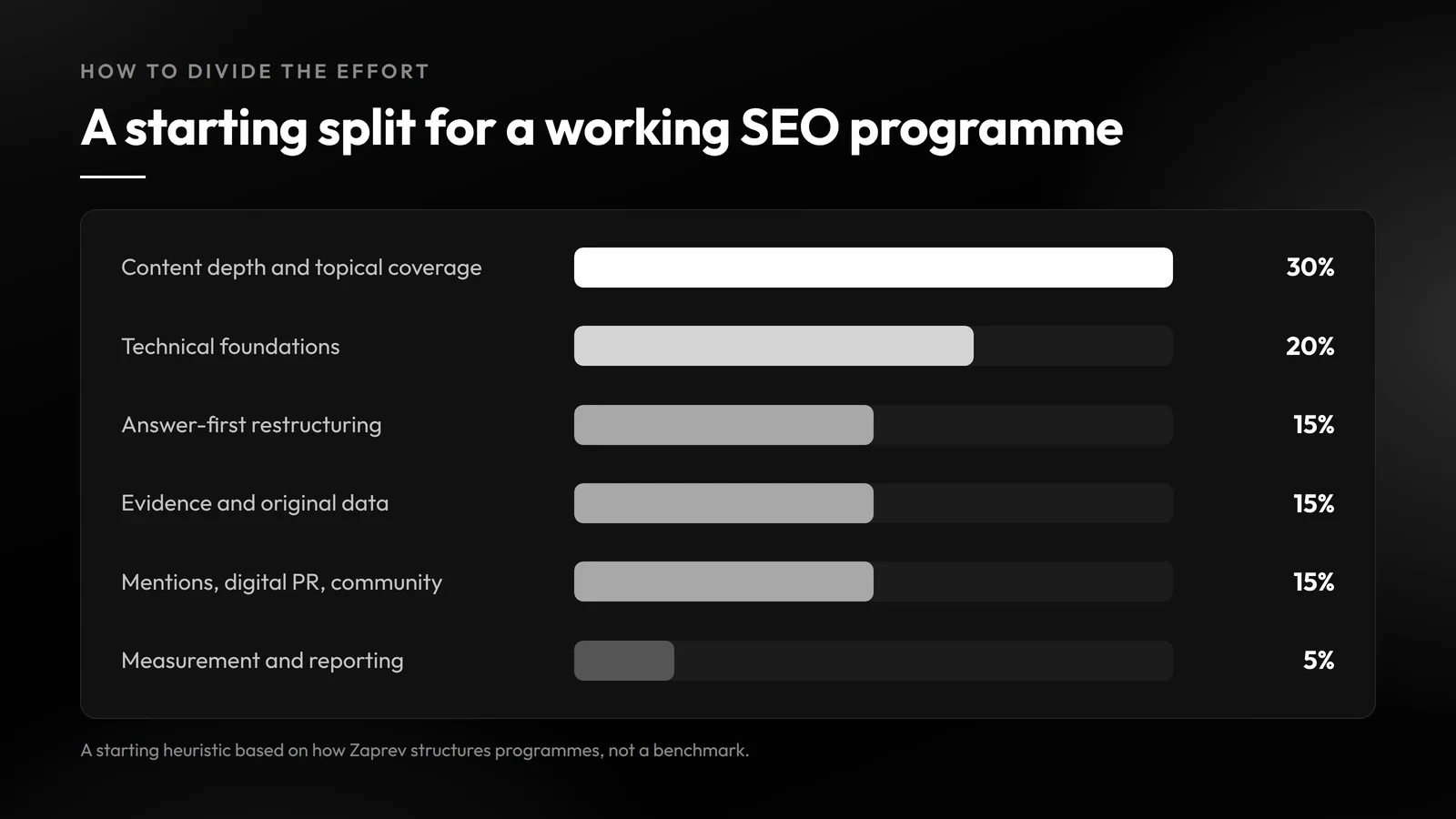
For most teams with a functioning SEO programme, a reasonable split looks like this:
Work | Share of effort | Serves |
|---|---|---|
Technical foundations, crawl access, rendering, speed | 20% | Both |
Content depth and topical coverage | 30% | Both |
Answer-first restructuring of existing high-value pages | 15% | Mostly AEO |
Evidence, original data, source attribution | 15% | Mostly AEO |
Off-page: mentions, digital PR, community presence | 15% | Both, weighted to AEO |
Measurement and reporting | 5% | Both, new capability for AEO |
Two observations. First, no line item is purely AEO, which is why a separate AEO budget usually signals a vendor problem rather than a strategy. Second, the highest-return work for most teams is the restructuring row, because it applies to pages that already have authority and only need reorganising.
When AEO is not worth the effort
Your technical foundations are broken. Fix crawling, rendering, and speed first. Passage optimisation on an unretrievable page is wasted.
You win on transactional or local intent. If people search your brand or a “near me” query and convert, AI answers about your category matter less.
Your buying cycle has no research phase. AEO pays off where buyers compare options before deciding.
You cannot produce evidence. If you have no data, no practitioner detail, and nothing to say that is not already on ten other sites, no amount of restructuring makes you the preferred source.
Important notes
This article reflects the position as of September 2026 and draws on published third-party research and Google’s own documentation.
The effort-split table is a starting heuristic based on how we structure programmes, not a benchmark. The right split depends on the state of your technical foundations and your category.
Correlation figures on brand mentions and freshness come from observational studies. They describe relationships in the data rather than proven causation.
Read more from the team: browse all our posts.
Frequently asked questions
What is the difference between AEO and SEO?
SEO optimises a page to earn a ranking position. AEO optimises a passage to be selected as the answer inside an AI-generated response. Most of the underlying technical and content work is shared.
Who should own AEO internally?
The SEO team, with structured input from content and PR. The measurement is closest to SEO, the restructuring is closest to content, and the brand-mention work is closest to PR.
Will AEO reduce my traffic?
AEO does not reduce traffic. AI answers do, by satisfying questions without a click. AEO is the response to that, and the compensation is that AI referrals convert well above organic in most published datasets because the visitor arrives after the comparison.
How do I measure AEO against SEO?
SEO uses rankings, clicks, and impressions. AEO uses citation share and share of voice across a fixed prompt set, sampled repeatedly, plus AI referral segments in analytics and Search Console’s generative AI reporting for Google.
See more
Want this run on your site?
We do the sitewide version, with the fixes prioritised and shipped.