Generative Engine Optimization: What It Is and What Works
Published
· Updated
Generative engine optimization is the practice of increasing the chance your content is retrieved, used and cited when an AI system generates an answer. The term comes from a 2024 ACM SIGKDD paper that measured visibility gains of up to 40%, with the largest gains going to lower-ranked pages.
The definition
A generative engine answers a question by retrieving material from the web and synthesising it, rather than returning a list of links. ChatGPT, Perplexity, Gemini, Claude, Microsoft Copilot, and Google’s AI Overviews and AI Mode all work this way.
GEO is the work of being one of the sources that answer is built from.
The distinction from SEO is not the tactics, which overlap heavily. It is the failure mode. In search, a weak page ranks low and still exists. In a generated answer that names four vendors, you are either in it or you are invisible, regardless of how you rank on the same query in classic search.
Where the term came from
This matters because it is the difference between a discipline and a sales category.
In 2024 a team of researchers published “GEO: Generative Engine Optimization” and presented it at ACM SIGKDD, one of the leading venues in data mining. The paper is on arXiv as 2311.09735. It coined the term and, more usefully, was the first controlled demonstration that content can be deliberately optimised for higher visibility in AI answers.
It is usually called the Princeton study. That is a simplification. The lead author, Pranjal Aggarwal, was at IIT Delhi; the Princeton affiliation comes from co-author Vishvak Murahari. A Princeton and IIT Delhi collaboration is the accurate description.
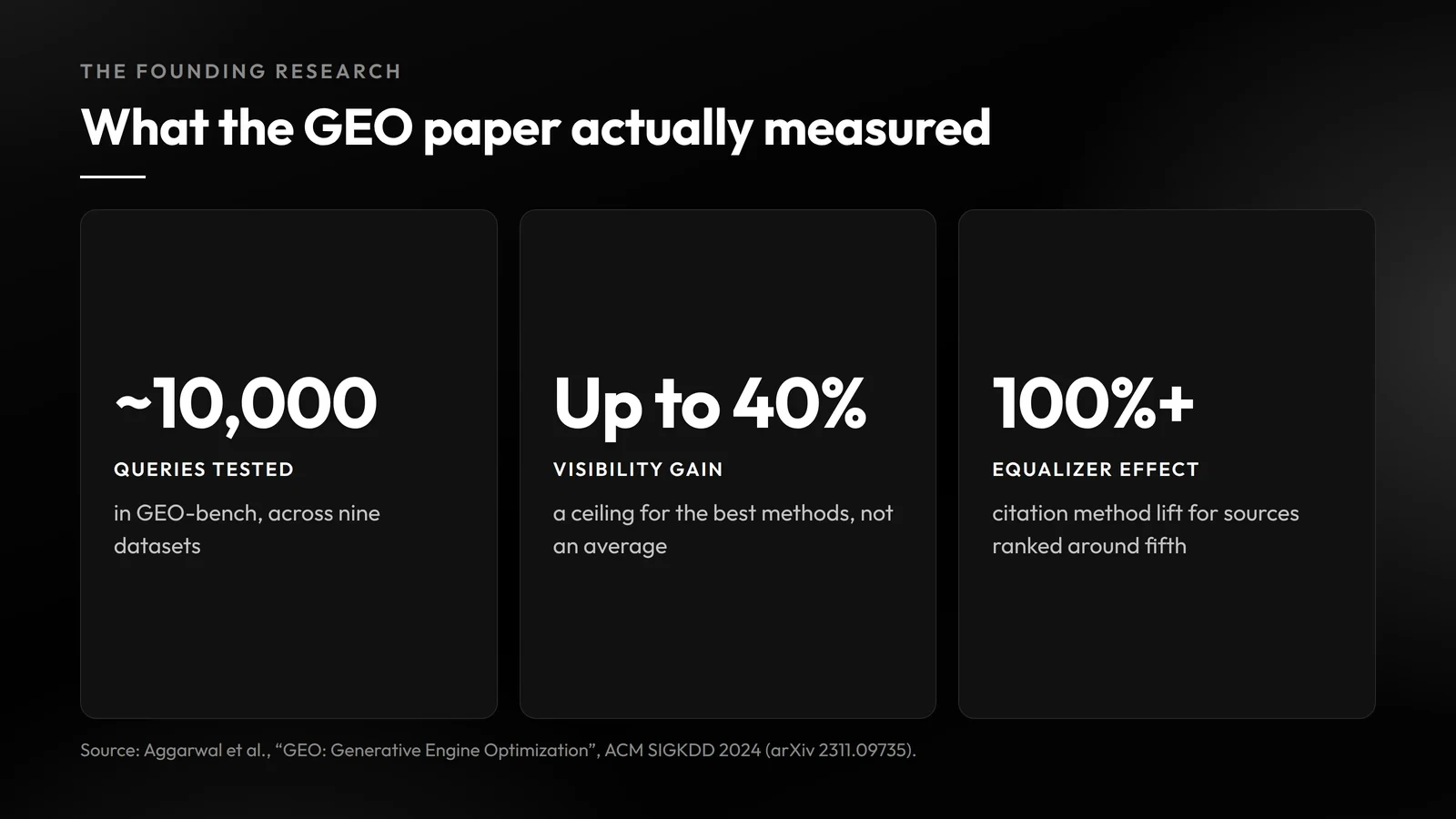
The researchers built GEO-bench, a benchmark of roughly 10,000 queries across nine datasets and multiple domains, then tested content modifications to see which changed how often a source was used and how prominently.
What the research actually found
Method tested | Reported effect |
|---|---|
Cite Sources | Strongest overall, roughly +30% to +40% on the paper’s position-adjusted visibility metric |
Quotation Addition | Among the top three, comparable magnitude |
Statistics Addition | Among the top three, comparable magnitude |
Fluency and readability improvements | Positive but smaller |
Keyword stuffing | No meaningful benefit |
Two details are worth carrying:
The 40% figure is a ceiling, not an average. It describes the best-performing methods under favourable conditions on a specific metric. It is not a promise for any individual page, and it is quoted far more loosely than the paper supports.
The equalizer effect is the interesting part. Sources ranked around fifth gained the most, with the citation method reported at over 100% improvement for that group. The paper’s argument is that because generative engines work by retrieval and synthesis rather than link-graph authority, factors like backlink strength disadvantage small creators less than they do in classic search. For a challenger brand, that is the whole commercial case for GEO.
What later research corrected
The founding paper is directional, not gospel, and the honest version of this topic includes the correction.
C-SEO Bench, a later systematic benchmark of conversational SEO tactics, found that most of the tactics circulating in the industry do not help, and several actively hurt, while plain source relevance keeps working reliably.
Take the two findings together and a defensible rule emerges: interventions that also make the page genuinely better for a human reader tend to hold up. Interventions that only make sense as a signal to a machine tend not to, and sometimes backfire.
Google’s own guidance, published 15 May 2026, points the same way. It states that its AI Overviews and AI Mode are rooted in its core Search ranking and quality systems, that optimising for AI experiences is still SEO, and it explicitly dismisses llms.txt, AI-specific schema, content chunking, and machine-flavoured writing.
GEO, AEO, LLM SEO, LLMO
The naming is a mess and it does not repay much attention.
Term | Usually framed around | Practical difference |
|---|---|---|
GEO | Generated answers broadly | None material |
AEO | Answer engines specifically | None material |
LLM SEO | The technical retrieval mechanics | Emphasis, not substance |
LLMO | Model-level brand presence | Emphasis, not substance |
The industry has not settled on a distinction and vendors pick the term that suits their positioning. Judge a provider on whether they can show you a documented prompt set with citation share over time. That is a real capability. Vocabulary is not.
For the comparisons themselves, see GEO vs SEO and AEO vs SEO.
What a GEO programme actually contains
Five workstreams. In order, because the earlier ones gate the later ones.
Crawler access. Retrieval crawlers and training crawlers are different user agents doing different jobs. Blocking OAI-SearchBot, Claude-SearchBot, or PerplexityBot removes you from eligibility for citations on those engines. Plenty of sites have done it accidentally, sometimes via a CDN rule or a CMS default. This is the first thing to check and the most common silent failure.
Page structure. Retrieval works at passage level. Every section should open with a direct, self-contained answer of roughly 40 to 60 words, with the detail after it. An analysis of 100 Google AI Overview citations found 55% came from the first 30% of the source page, so placement matters in a way it never did for ranking.
Evidence. Specific figures, named and dated sources, original data, real practitioner detail. This is what the founding research measured and it remains the most controllable lever, particularly for brands without strong domain authority.
Entity and brand presence. The strongest off-page correlate is not links. Ahrefs, across 75,000 brands in 2026, found branded web mentions correlated with AI visibility at 0.664, roughly three times the strength of backlinks. Being named consistently across review sites, industry press, communities, and comparison content is what makes a brand look like a real entity.
Measurement. A documented prompt set of real buyer questions, run repeatedly per engine, tracked as citation share and share of voice. Search Console added generative AI performance reporting in June 2026 for Google surfaces.
The technical detail behind workstreams one and two is in our LLM SEO guide. If you want this run as a managed programme rather than assembled in-house, that is what our generative engine optimization services cover.
How GEO is measured
Rank tracking does not transfer. Generative answers vary between runs, personalise by user, and shift with model updates. Citation rates on a fixed prompt set can move 40% to 60% month to month with nothing changed on your side.
So measurement is statistical:
Citation share. How often you appear across the prompt set.
Share of voice. How often relative to named competitors on the same prompts.
Prompt coverage. How much of the buyer question space you appear in at all.
Found but not cited. Where you were retrieved and passed over, which separates an access problem from a citability problem.
AI referrals and pipeline. Segment them in analytics, since they are routinely logged as direct.
One number without a named prompt set behind it is not a measurement.
Realistic expectations
Two timelines run at different speeds, and conflating them is how GEO gets oversold.
Weeks. Crawler access fixes, rendering fixes, and answer-first restructuring of existing pages. These are mechanical, and if the page already has authority, results can appear quickly.
Quarters and years. Entity strength and brand-mention density. This accrues through real coverage, product launches, credible placements, and time. It is largely outside any agency’s direct control, which is worth knowing when someone quotes you six months to build it.
Who GEO is for
It earns attention if your buyers research before they decide: B2B software, financial services, healthcare, education, professional services, and considered consumer purchases. Those are the categories where someone asks an assistant to compare options, and where absence from the shortlist costs pipeline.
It matters less for local and transactional intent, or where you already own brand demand.
It matters not at all until your technical foundations work. A page an engine cannot retrieve cannot be cited, and no amount of GEO tactics changes that.
Important notes
This article reflects the position as of September 2026 and cites published academic research alongside vendor and platform documentation.
The GEO paper’s findings come from a controlled benchmark against a defined visibility metric. They demonstrate that content changes can shift measured visibility, not that any specific result will hold for a given site.
Correlation figures, including those on brand mentions, come from observational studies and describe relationships in the data rather than proven causation.
Statements about Google’s systems come from Google Search Central and named Google staff and apply to Google’s AI surfaces only.
Read more from the team: browse all our posts.
Frequently asked questions
How do I know whether GEO is working?
Track citation share and share of voice against a fixed, documented prompt set, per engine, over months. Support it with Search Console’s generative AI reporting and a segmented AI referral view in analytics.
How long does GEO take to work?
Structural and access fixes can register in weeks. Brand and entity strength moves over quarters and years, and no provider can compress that meaningfully.
Do I need llms.txt for GEO?
No. Google says it does not use the file, and crawler log studies show AI bots rarely request it. It has genuine value for developer documentation only.
Is GEO the same as AEO?
In practice, yes. The terms describe overlapping work with no settled distinction, and providers use whichever suits their positioning.
See more
Want this run on your site?
We do the sitewide version, with the fixes prioritised and shipped.