Answer Engine Optimization: How to Get Cited by AI
Published
· Updated

Answer engine optimization is the practice of structuring content and building the authority signals that make an AI answer engine cite your page. What works: answer-first structure, original data, named sources and wide brand mentions. What does not: llms.txt, AI-specific schema and content chunking.
What AEO is, and what it is not
Answer engine optimization makes the useful part of a page easy to find and hard to misinterpret, then gives the engine enough context and evidence to use it safely.
The shift is that the whole page no longer has to win. A definition, a comparison table, a statistic, or a specification can become the cited answer on its own. Your job is to make sure that unit is clean, self-contained, and attributable.
AEO is not a replacement for SEO. Google’s official guidance on generative AI features, published 15 May 2026, states that its AI Overviews and AI Mode are rooted in its core Search ranking and quality systems, and that optimising for AI experiences is still SEO. Google went further and updated its “Do you need an SEO?” hiring guidance to name AEO and GEO services explicitly, advising site owners to check whether a provider’s advice aligns with that official guidance.
For the operational comparison with traditional SEO, see AEO vs SEO.
What counts as an answer engine
Surface | What it is | Why it behaves differently |
|---|---|---|
Google AI Overviews | AI summary above traditional results | Built on Google’s core index and ranking systems |
Google AI Mode | Full conversational search experience | Heavier query expansion, longer answers, fewer links surfaced |
ChatGPT search | Retrieval inside ChatGPT | Dominant source of AI referral traffic by a wide margin |
Perplexity | Answer engine with prominent citations | Citations surfaced more visibly, so referral clicks are higher per answer |
Gemini | Google’s assistant | Growing share of AI referrals through 2026 |
Claude | Assistant with web access | Smaller referral volume, research-heavy usage |
Microsoft Copilot | Assistant across Bing and Windows | Bing gives site owners more visibility data than most |
How an answer engine chooses its sources
Understanding the pipeline is what lets you diagnose a failure instead of guessing at it.
Query expansion - The engine breaks the question into multiple sub-questions and runs them in parallel. Google introduced the term query fan-out publicly at Google I/O in 2025. Simple factual questions may skip this. Comparative and exploratory ones do not.
Retrieval - Each sub-question pulls candidate passages, typically from an underlying search index plus live fetches.
Shortlisting - Candidates are filtered on relevance, authority, recency, and diversity of perspective. Research by Dan Petrovic found that on-page elements such as the title, meta description, and URL influence which pages get read in full.
Reading - Survivors are fetched and parsed properly.
Selective citation - Sources are attached to specific claims that support the reasoning. Not every retrieved document gets cited.
Synthesis - The answer is composed, with conflicts resolved in favour of fresher and more authoritative sources.
The blunt version, in Eli Schwartz’s phrasing, is that the vast majority of pages are considered and rejected before the answer is ever written. Being retrieved is not the same as being cited, and several visibility tools now expose a “found but not cited” view that makes this painfully clear.
The full stage-by-stage diagnostic sits in our LLM SEO guide.
What the evidence says actually works
The founding research is the paper that named the field: “GEO: Generative Engine Optimization” by Aggarwal, Murahari, Rajpurohit, Kalyan, Narasimhan, and Deshpande, presented at ACM SIGKDD in 2024 and usually called the Princeton study, though the lead author was at IIT Delhi. It tested content interventions across roughly 10,000 queries and nine datasets.
Intervention | Effect reported |
|---|---|
Adding citations to credible sources | Strongest single method, around +30% to +40% on the paper’s visibility metric |
Adding relevant quotations | Comparable lift, among the top three methods |
Adding statistics | Similar magnitude |
Keyword stuffing | Ineffective |
The paper also reported an equalizer effect: lower-ranked sources benefited disproportionately, with the citation method lifting visibility by over 100% for pages ranked around fifth. That is the most commercially interesting finding in the whole literature, because it suggests evidence density can partially substitute for domain authority.
The necessary corrections. A later benchmark, C-SEO Bench, tested conversational SEO tactics systematically and found that most of them do not help and several actively hurt, while plain source relevance keeps working. Take the Princeton findings as directional rather than as a recipe, and treat any tactic that does not improve the page for a human reader with suspicion.
Three other findings worth building around:
Brand mentions beat backlinks. Ahrefs, across 75,000 brands in 2026, found branded web mentions correlated with AI visibility at 0.664, roughly three times the strength of backlinks.
Freshness is weighted heavily. Ahrefs analysed 17 million citations and found AI-cited URLs were 25.7% fresher on average than URLs in standard organic results.
Position on the page matters. An analysis of 100 AI Overview citations found 55% came from the first 30% of the source page.
The AEO checklist, by layer
Work top down. The earlier layers gate the later ones.
Layer 1: Retrievability
Retrieval crawlers are not blocked in robots.txt or at the CDN. Distinguish training crawlers from the agents that fetch pages at answer time.
Content is present in the server-rendered HTML, not injected by client-side JavaScript.
Pages return clean status codes and load quickly.
Layer 2: Answer-first structure
Each section opens with a direct, self-contained answer of roughly 40 to 60 words.
The main answer sits high on the page, not after 800 words of preamble.
Headings follow the question flow a reader actually has.
Comparisons are in tables, because tables survive extraction cleanly.
Layer 3: Evidence
Specific figures rather than vague claims.
Named sources, with dates.
Original data, first-party research, or genuine practitioner detail. This is the strongest reason for an engine to prefer you over a generic source.
Layer 4: Entity and brand
Consistent brand, product, and personnel naming across your site and off it.
Presence where your category is discussed: review platforms, industry press, communities, comparison sites.
Accurate structured data where it reflects visible page content. Useful for machine clarity, not a citation switch.
Layer 5: Freshness
A real update cadence on commercially important pages.
Substantive revision, not a modified date.
What to stop doing
Google’s May 2026 mythbusting section is unusually direct, and it invalidates a fair amount of what has been sold as AEO:
llms.txt is not needed. Google may crawl it like any page but does not treat it specially. See our llms.txt guide for the wider crawler evidence.
AI-specific structured data does not exist. Structured data is not required for AI Overviews or AI Mode.
Content chunking is unnecessary. There is no ideal page length and no requirement to break content into tiny pieces.
AI-flavoured writing is not needed. No robotic prose, no prompt-like headings.
FAQ schema as a citation lever no longer buys a rich result either, since Google retired FAQ rich results in May 2026. Write FAQs when readers genuinely have those questions.
How to measure AEO
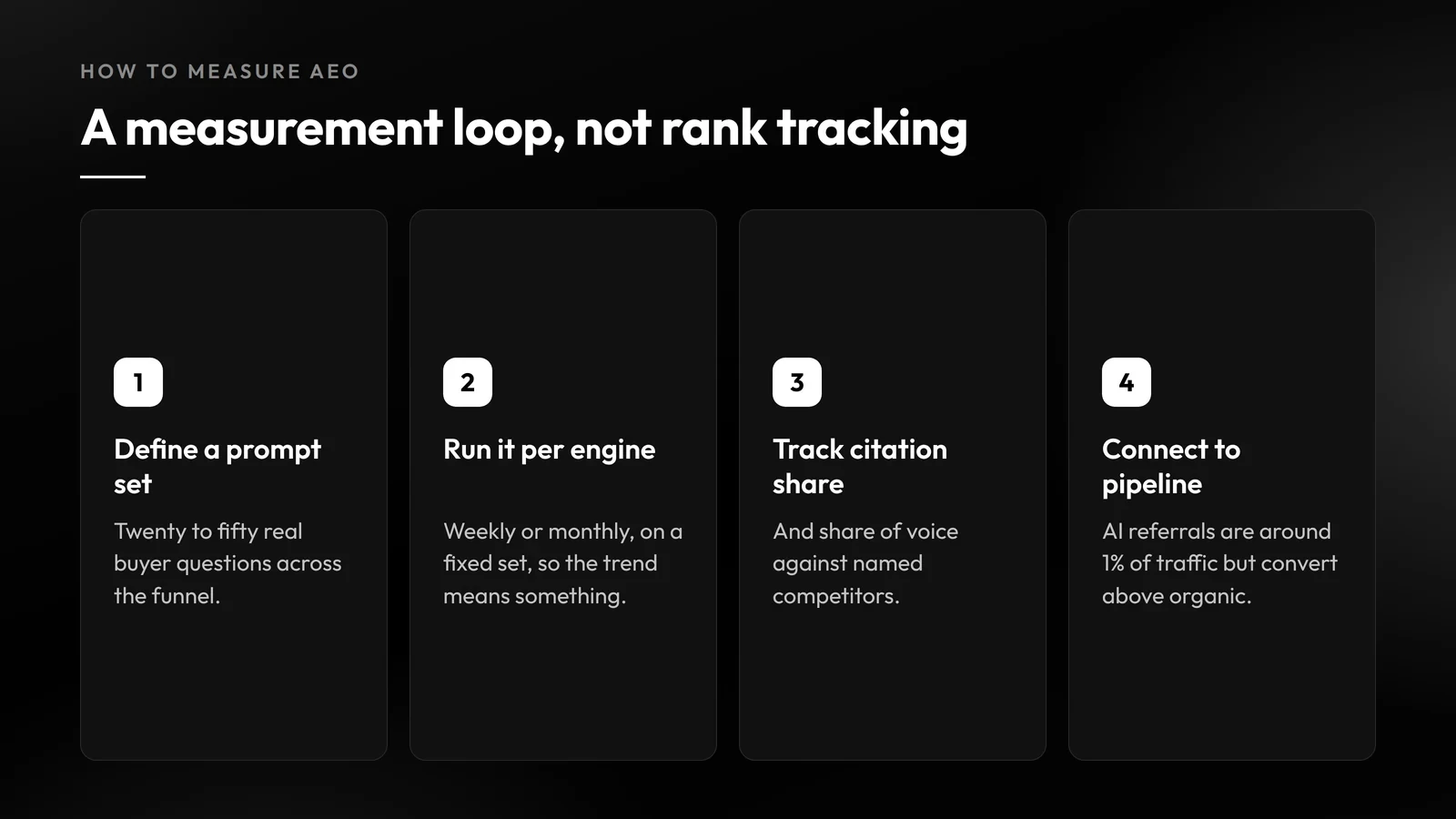
Rank tracking does not transfer. Build a measurement loop instead:
Define a prompt set - Twenty to fifty real buyer questions across the funnel, in the language your buyers use.
Run it repeatedly, per engine - Weekly or monthly, on a fixed set, so the trend means something.
Track citation share and share of voice - How often you appear, and how often relative to named competitors.
Add first-party data - Search Console gained generative AI performance reporting in June 2026 for Google surfaces. Segment AI referrals in analytics, since they are commonly misattributed as direct.
Connect it to pipeline - AI referral volume is small, commonly around 1% of site traffic, but converts well above organic in most published datasets because the visitor arrives after the comparison rather than before it.
Tooling for each of these steps is covered in best AI SEO tools 2026, and you can get a baseline with our free AI visibility checker.
Read more from the team: browse all our posts.
Frequently asked questions
What is answer engine optimization?
The practice of structuring content and building authority so that AI answer engines select your page as a source when generating an answer. The goal is being cited and mentioned, not ranked.
Is AEO the same as GEO?
The industry uses them almost interchangeably. AEO is usually framed around answer engines, GEO around generated answers more broadly. There is no settled distinction, so judge providers on method rather than vocabulary.
Is AI traffic worth chasing if the volume is small?
Usually yes, because the visitor quality is different. AI referrals typically sit near 1% of traffic but convert several times better than organic across most published studies, since the click comes after the engine has already compared options.
Why does my page rank well but never get cited?
Ranking and citation overlap by roughly 38% in Ahrefs research, so they are related but far from identical. The usual causes are a buried answer, thin evidence, staleness, or a retrieval crawler that cannot reach the page.
See more
Want this run on your site?
We do the sitewide version, with the fixes prioritised and shipped.