How Higgsfield Grew: It Picked a Customer, Not a Market
Published
· Updated

Higgsfield's first product, a consumer video app, reached a million users in two months. That sounds like a startup taking off.
But the users didn't stay. The company spent more than $10M before it found a product that worked.
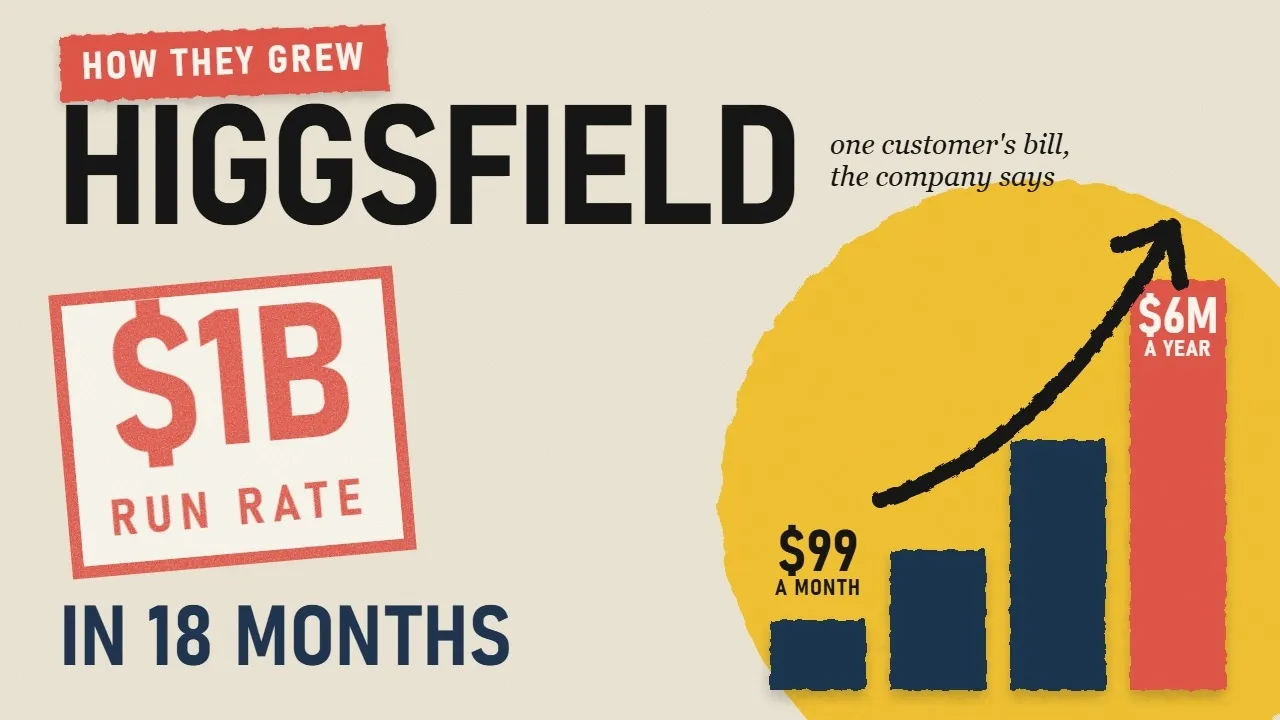
It started over in March 2025 as a browser tool. In September 2026, Higgsfield passed $1B in annualized revenue run rate.
The turnaround alone would be a good story. What makes it worth examining is what Higgsfield sells: access to video and image models that mostly belong to other companies. The way I see it, the space is cluttered: Canva, Adobe and dozens of AI tools sell many of the same models and fight for the same searches.
So how did a company selling technology anyone else could sell become the one people went looking for?
That's the question I want to work through, because the answer connects who you choose to serve, how you get found, and what happens after the first purchase.

Walking away from a million users to build for professionals
Picture the company in the spring of 2024. Its app, Diffuse, let people put themselves into AI-generated video scenes, free at launch in a handful of markets. It reached 1M users in two months. Most founders would read that as the moment to pour fuel on the fire.
The users left instead, and the company kept trying for about a year. By the time it stopped, it had spent more than $10M of its seed money. What it did next is the interesting part. It didn't rework the consumer funnel. It went and interviewed top creative directors, and found that their shared need was precise camera control.
Why would a team walk away from a million users to build for a few people who direct ads and films?
Because the million users had the wrong economics. CEO Alex Mashrabov put it plainly: "We began on mobile, but realized generative AI doesn't change the economics of mobile apps - high churn, small ticket sizes, limited expansion." A casual user tries a novelty, shares one clip and leaves. A professional who makes video for a living (a VFX artist, an ad maker, a social media marketer) has a reason to come back every week. They need control over camera moves and consistent characters, which is hard to deliver on a phone. They use the output in paid work, so they'll pay for it. And their spending can grow as their own work grows.
On March 31, 2025, Higgsfield relaunched as a browser product built for professional creators and marketers. It led with a video model built around preset cinematic camera moves, the exact thing the creative directors had asked for. A week later its GPUs were running at 100%. Within weeks it reached about $10M in annualized revenue.

I think this was the most important decision in the whole story, and it's easy to misread. AI video wasn't a new market. It was already crowded. The closest thing to a blue-ocean move was choosing professional creators and agencies over casual consumers. The same technology, pointed at a different customer, became a different business.
It also created a new problem. Higgsfield now had a product professionals wanted, in a category full of tools selling the same models. How would they find it?
Getting people to search for the name instead of the category
Put yourself in Higgsfield's position in mid-2025. You're a small company in a crowded category. The obvious way to get found is to pay for clicks on searches like "ai video generator", where you'd be bidding against companies with far bigger budgets. That's a quick way to spend a Series A.
Higgsfield didn't try to outbid anyone. It didn't buy category searches, and it ran no Meta ads of its own. That doesn't mean it had no paid acquisition: it still paid creators to post, which comes up in the next section. Yet in the US, searches for "higgsfield" rose to more than four times their 2025 level, while searches for "ai video generator" grew about 10%.

How does a company that doesn't buy its category's searches end up with a name that outgrows the category?
The engine was model launches. Each time a frontier video or image model shipped, Higgsfield put it on the platform at launch, usually with a discount or a time-boxed "unlimited" window, and paired it with its own tools for camera control and consistent characters. Sora 2 arrived in October 2025. Kling 3.0 came in February 2026 with exclusive day-zero access. The Seedance 2.0 launch at 65% off became one of the company's most-viewed posts. Each time, someone else's model release turned into a Higgsfield sales event.
Then creators did the advertising. Free outputs carried a watermark, so work made on the free plan said where it came from. Professional-looking clips got posted, and each one showed what the product could do better than any feature list. The paid side was small in 2025: an invite-based creator partner program and a couple of influencer-marketing hires. Early on, unpaid creator posts outnumbered paid ones about five or six to one.
The consequence is that people who saw a new model working didn't go looking for the model's maker. They went looking for the place where they'd seen it, with the discount attached. Higgsfield's revenue followed: $50M in annualized revenue by September 2025, the month it raised a $50M Series A.
The obvious objection is the wave. 2025 and 2026 brought a run of much better third-party video models, and any tool that resold them grew. I grant that. They were on a wave, and they rode it really well. But the wave lifted the whole category, and that more-than-fourfold rise against 10% is the part the wave doesn't explain. People came looking for Higgsfield, not for a model.
My read is that early creator growth was mostly organic and cheap. The output was the ad, which only works because the relaunch made something professionals wanted to show off.
Their move: Higgsfield was live with each new frontier model on launch day, with a discount or a time-boxed "unlimited" window attached.
Your move: If you build on other companies' models, platforms or products, plan your calendar around their releases and be live on day one with an offer and a demonstration. This depends on releases your buyers already care about and on shipping fast enough to be first. It fails when the release is exclusive to its maker, and it gets expensive when each launch needs a deeper discount than the last.
But unpaid posting has a ceiling. Sooner or later you have to decide whether to pay for more of it, and when.
Paying for distribution only after the money arrived
On January 15, 2026, with its annualized revenue run rate at $200M, Higgsfield raised an $80M Series A extension.
Three days later it launched Earn, which pays creators for each approved public video made with Higgsfield, with caps on what any one video can earn. More than 10,000 creators have been paid through its creator programs, and more than $1M distributed.
Cash contests started the following month, beginning with a $500K action-scene contest.
If creator posts were what built the name, why wait until 2026 to pay for them at scale?
Because paying for posts costs real money, and it only works on top of something people already want to post about. Look at how the programs are built. Every open contest made a public post part of a valid entry, and most scored social engagement. Prize money buys a burst of branded, public videos made with the product.
The $1M film festival that ran from August asked for films made entirely on Higgsfield, watermarked and posted publicly. It drew 67,223 entries. Each of those is a demonstration, and each lands in front of the entrant's own audience.
The per-video caps on Earn matter too. They bound the cost of each post, which is how you keep a payout program from turning into an open checkbook.

An affiliate program opened to everyone in August 2026, paying a share of subscriptions in cash. That was the same month as the $400M Series B at $5.4B, led by DST Global.
Higgsfield also built a channel of its own on demonstration. Its YouTube channel has 458K subscribers, and what does well there is showing, not telling: original films and workflow tutorials, which outperform its product Shorts. An Academy followed in July 2026. Neither lists features. Both show what people can make and how.
The consequence is a much bigger version of what worked in 2025, and a cost line that only a company with revenue and fresh capital can carry. I think the order is the most copyable part of this story, and the part most often skipped. Funding paid to scale what was already working. A payout program launched before anyone wants to post about your product buys reluctant content from people chasing the fee. Launched after, it gives something that already works more volume.
All that attention brings people in. The next question is how much each of them can become worth.
Adding search capture and growing the account
Imagine you run a creative agency. A client needs a campaign this week. Next week, another client needs several variations, and the week after that a third wants the same ad cut for five platforms. Every new project creates more video work, spread across several people on your team.
Now one pricing detail becomes interesting. Higgsfield's Team and Scale seats cost more per credit, up to $0.079, than its largest individual plans, which go as low as $0.030.
Why would a team pay more for the same credits?
Because the team isn't only buying credits. It's buying pooled credits across seats, more jobs running at once, queue priority, single sign-on and admin controls. The purchase is about how several people get their work done. Higgsfield built that ladder step by step: Teams in November 2025, then Scale, then Higgsfield for Enterprise in August 2026 with dedicated US GPUs and annual credit-pool contracts. It went into the tools professionals already use, with plugins for Adobe, Figma and Blender, an extension for ChatGPT, an MCP server so AI agents can generate with it, and a pay-per-generation API from September 2026.

It also hired the people to sell all this. Its enterprise and sales team grew from 19 to 50 in one quarter, between Q2 and Q3 2026.
The consequence shows up in the accounts. One client started at $99 a month and pays $6M a year six months later.
That account isn't the only one growing. Month-12 net revenue retention is over 300% in the business segments.
The revenue mix moved with it. Subscriptions fell from more than 90% of revenue to just over 60%, as on-demand usage grew.
Search capture arrived around the same time, and late. The first SEO and organic-growth hires came in March and April 2026, about a year after the relaunch. Use-case, tool and model landing pages followed, and the blog roughly tripled its output in mid-2026. Its own Google text ads started that April and are still a small set. On paid search in particular, Higgsfield is early. Where capture clearly works is monetization: turning users into larger, expanding accounts.
This is where the March 2025 choice pays off, and it's why I keep coming back to it. A casual consumer on a small monthly plan has little room to expand. An agency that lands on a self-serve seat can grow into a contract without ever switching products. In my experience, land and expand is what drives net revenue retention, and it only works if the customer you picked has room to spend more.
That growth has a price, though, and Higgsfield is still paying it.
What growing this way costs now
In the week Higgsfield crossed $1B, it didn't slow the promotions down. It returned the subscription credits users had spent that month and offered cashback on API spend from a $20M pool.
What does it cost to keep an engine like this running?
The first cost is promotion. Launch discounts of 65% to 70% and time-boxed unlimited windows keep the model-launch engine going. My concern is that they also teach buyers to wait for the next offer. Pricing and credit cost is what users on Reddit and X complain about most. "Unlimited" plans that still queue or carry limits are a separate one, and so is billing. That's the friction of selling through credits and offers.
The second is creator spend. Higgsfield's cash contest pools in 2026 add up to more than $1.62M, on top of what Earn has paid out. Each new program sets the baseline the next one has to beat.
The third is dependence. Most of the headline models belong to ByteDance, Kuaishou, Google, OpenAI and xAI, and their terms can change. When the Sora 2 API shut down, Higgsfield published a guide to migrating to alternatives. Its hedge is owning the customer. It has its own models for camera control and characters, and in over 40% of cases it decides which model does the work. If customers come for Higgsfield rather than for a model, a provider leaving hurts less.
My judgment is that the bill is real but the trade is a sound one, as long as the account expansion keeps outrunning the promotion. The day new customers come only for the next discount, the model-launch engine becomes a cost with nothing behind it.
Their move: Higgsfield hedged its dependence on other companies' models by building its own for camera control and characters, and by deciding which model does the work in over 40% of cases.
Your move: If your product resells someone else's technology, track how often the customer picks the supplier and how often you do, and move that share toward you with defaults, routing and your own tools. This depends on having several suppliers that can do the same job. It fails when customers come for one specific model, because then the supplier owns the relationship.
What I'd take from Higgsfield
Choose the customer, then land and expand
The blue-ocean move here was choosing a customer, not a market. Pick the segment that uses more, pays for commercial value and has a path to larger spend, then start small with each account and grow it. This needs pricing that can capture the growth: seats, pooled credits, contracts, usage. It fails when you relabel a consumer product as "pro" without the control professionals need, or when your price list has nowhere to expand into.
Check whether demand exists before you pick a channel
Higgsfield created demand first and added capture once demand existed. Before you copy any channel, answer these:
Are people already searching for what you sell? If so, focus on Google, paid and organic.
Is your category research-heavy, where buyers compare options before they choose? Then organic search matters even more.
Are you still creating demand? Then focus on Meta, affiliates and creator programs.
Can you demonstrate the product live? If you can, do it. Show what people can make and how, not a feature list.
This depends on a product whose output is visible and worth showing. It fails when you buy category searches against incumbents with bigger budgets before anyone knows your name, or when you demonstrate a product whose value doesn't show on screen.
Scale the expensive programs after the money
Creator payouts, cash contests and affiliate programs at scale cost real money. Higgsfield's early creator growth came before the big payouts; the payouts came after revenue and funding. If you're well funded, do all of them. If you're not, start with one channel. My recommendation is Meta first, because it's quick to experiment on and flexible with budgets. That comes from my own experience, not from Higgsfield, which ran no Meta ads of its own, though it still paid creators to post. Creator programs take time, unless you have a tailwind like Higgsfield had. Copying fails when you launch big contests and per-post payouts before anything is working, or when you expect a creator program to move fast without a wave behind it.
Don't copy, adapt
Be honest about which parts of Higgsfield's growth came from the wave (a fast run of frontier model releases, access to other companies' models) and which were choices anyone can make (the customer, the order of channels, the path from a self-serve seat to a contract). Treating a model-release tailwind as a repeatable playbook is how case studies mislead. Don't copy Higgsfield's strategy. Adapt it to your business, your customers and your stage.
Where the moat is now
So, back to the question: how did a company selling technology anyone could sell become the one people went looking for?
It chose a customer before it chose a market, trading casual users for professionals and agencies whose own work keeps growing. It made people search for its name instead of buying the category's searches, by turning every new model into a Higgsfield launch and letting creators post the results. It paid to scale that only after it had revenue and fresh funding. And it built the seats, contracts and integrations that let a $99 account become a $6M one.
Put together, those moves form a flywheel.

The step that turns it back to the start is the last one. Revenue and each funding round pay for model access, compute, creator payouts and the next contest, so the next model goes live at launch with an offer. That's why the order mattered. The expensive programs came after the revenue and funding to pay for them, and in my view each turn depends on accounts expanding enough to cover the next one. Where it leaks is pricing, the thing users complain about most.
Models are being democratized. My view is that in earlier technology cycles, the money often went to whoever controlled distribution rather than to whoever invented the technology, and AI looks like it's following the same pattern. When anyone can license the same engine, the lasting advantage sits with whoever owns the customer: the name people search for, the tool built into their workflow, and the pricing that gives an account room to grow. If you're working out that order for your own company, talk to us at Zaprev.
Research covers public information through early October 2026. Company figures are as stated by the company. Search figures are estimates, and ad and LinkedIn figures are observations.
Read more from the team: browse all our posts.
Want this run on your site?
We do the sitewide version, with the fixes prioritised and shipped.

