GEO vs SEO: What Actually Changed
Published
· Updated
SEO earns a position on a results page. GEO earns a place among the handful of sources an AI answer is built from. Google’s May 2026 guidance says optimising for its AI features is still SEO. Treat GEO as a measurement and structure layer on a working SEO programme, not a separate budget line.
The two definitions, kept short
SEO improves a site’s visibility in traditional search results. The unit is the page, the outcome is a ranking position, and the reward is a click.
GEO improves the odds that a brand or page is retrieved, used, and cited when a generative engine composes an answer. The unit is the passage, the outcome is a citation or a mention, and the reward is often influenced without a click.
Both terms are contested. Some people say AEO, some say LLM SEO, some say LLMO. They largely describe the same work. We cover the terminology in what is generative engine optimization and the comparison set in AEO vs SEO.
Start with what did not change
This matters more than the list of differences, because most of the money wasted on GEO in the last two years was spent on tactics that were never doing anything.
Google’s May 2026 guide, written by John Mueller and published on Search Central, answers the question directly. Asked whether SEO is still relevant for generative AI search, the document’s answer is yes. Its generative features run on the same index and the same quality systems as the ten blue links.
Its mythbusting section names tactics you can stop paying for:
llms.txt. Not used. Google may crawl it like any page, but it is not treated specially. The wider evidence is worse than that: bot log studies show AI crawlers rarely request the file at all.
AI-specific structured data. No special schema.org markup exists for AI Overviews or AI Mode, and structured data is not required for them.
Content chunking. There is no requirement to break content into small pieces, and no ideal page length. Google’s systems handle multiple topics on one page.
AI-flavoured writing. No special style is needed. Write for readers.
Google also retired FAQ rich results in May 2026, so FAQPage markup is no longer a route to a rich result, though it remains a reasonable machine-readable structure when the page genuinely contains questions.
One caveat carries the whole thing: Google speaks only for Google. ChatGPT, Perplexity, and Claude run their own retrieval stacks and publish far less about them. Google’s guidance is authoritative for AI Overviews and AI Mode, and merely suggestive elsewhere.
The five things that did change
1. The unit of visibility is the passage, not the page
Classic search ranks documents. Generative engines retrieve passages. A model pulls the two paragraphs that answer a sub-question and ignores the rest of the page, which means a strong page with a buried answer loses to a weaker page with a clean one.
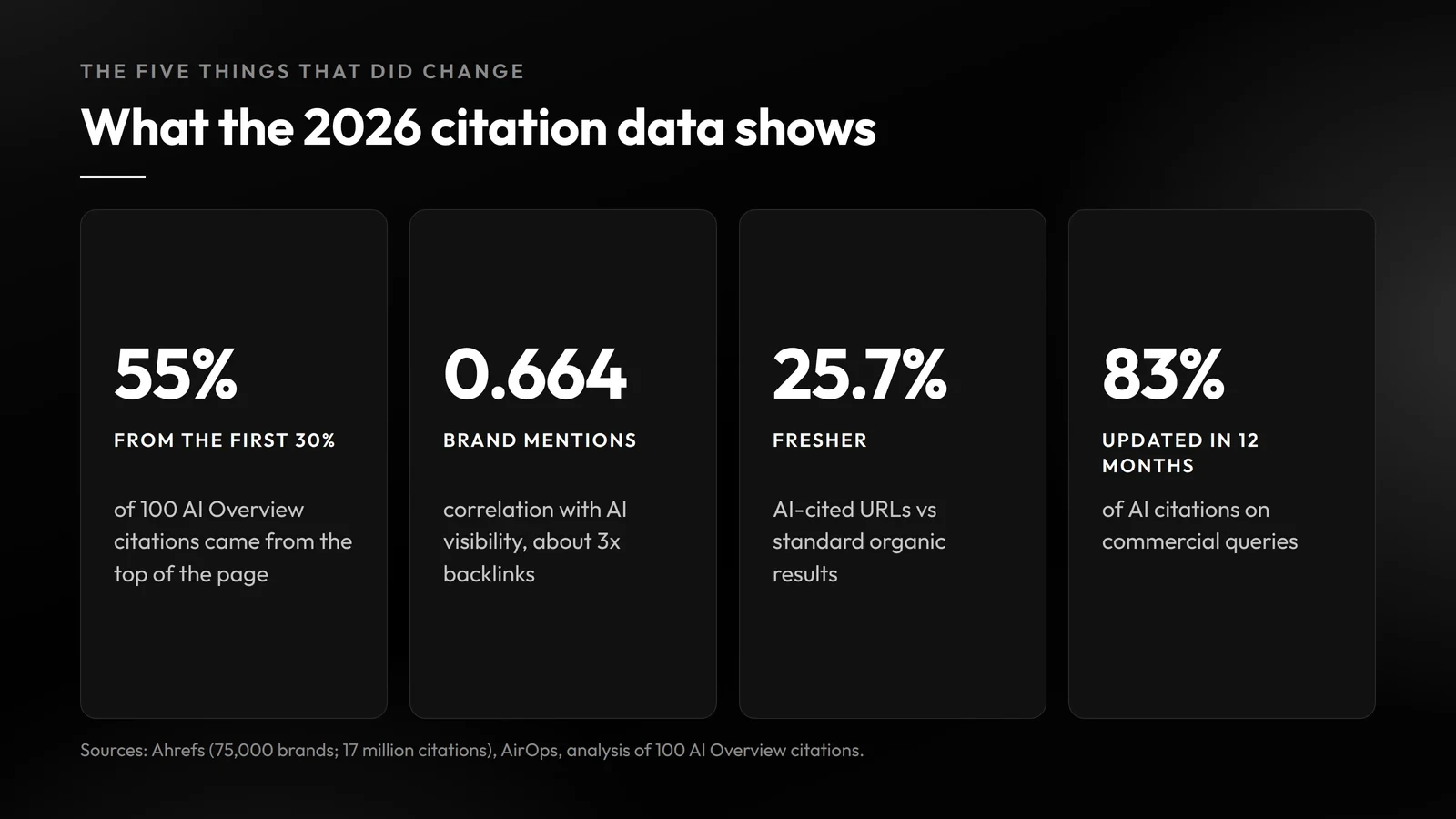
An analysis of 100 Google AI Overview citations found 55% came from the first 30% of the source page. Position within the document now matters in a way it never did for ranking.
2. Absence is the failure mode
If you rank eleventh, you still exist. Somebody scrolls. If an AI answer names four vendors and you are not among them, you are not visible at all in that answer, no matter how well you rank on the same query in classic search. There is no page two.
That is the specific risk GEO addresses and SEO does not measure.
3. Measurement became sampling
Rank tracking works because a query returns a stable, checkable result. Generative answers do not behave that way. The same prompt returns different sources on different days, personalisation shifts results, and citation rates for a fixed prompt set can swing substantially month to month.
So GEO measurement is statistical. You define a prompt set that reflects real buyer questions, run it repeatedly across engines, and track citation share and share of voice as trends. A single spot check tells you nothing. This is also why any agency reporting a single AI visibility number without naming its prompt set is not really measuring anything.
Google added generative AI performance reporting in Search Console in June 2026, which gives first-party impression data for its own AI surfaces. That helps, and it covers only Google.
4. Brand mentions started outweighing backlinks
This is the finding that should change budgets. An Ahrefs study of 75,000 brands in 2026 found branded web mentions correlated with AI visibility at 0.664, roughly three times stronger than backlinks did.
Being talked about across the open web, including forums, review sites, and industry press, appears to matter more to a retrieval system than the link graph does. Corroboration across independent sources is what a model is implicitly checking.
The uncomfortable implication is that this is slow. Brand-mention density accrues over years through real coverage, product launches, and credible placements. A six-month engagement promising to move it is selling something it cannot deliver.
5. Freshness carries more weight
Ahrefs analysed 17 million citations and found that URLs cited by AI assistants were on average 25.7% fresher than URLs ranking in standard organic results. Separately, AirOps reported that for commercial and evaluation-stage queries, 83% of AI citations came from pages updated within the past twelve months, with more than 60% refreshed within six months.
Classic SEO rewards a page that has been ranking for four years. Generative retrieval discounts it. That argues for a genuine update cadence on your commercially important pages rather than a publish-and-forget model.
Side by side
SEO | GEO | |
|---|---|---|
Surface | Google and Bing results pages | AI Overviews, AI Mode, ChatGPT, Perplexity, Gemini, Claude, Copilot |
Unit optimised | The page | The passage |
Outcome | A ranking position | A citation or a brand mention inside an answer |
Failure mode | Ranking low | Not appearing at all |
Primary metric | Rankings, clicks, impressions | Citation share, share of voice, prompt coverage |
Measurement method | Deterministic rank checking | Repeated sampling across a prompt set |
Strongest off-page signal | Backlinks | Branded mentions and corroboration |
Freshness sensitivity | Moderate | High |
Attribution | Reasonably clean in analytics | Partly invisible, often misattributed as direct |
Where the two overlap, which is most of it
Ahrefs research found roughly 38% overlap between AI citations and top-ten organic results. Read that both ways. It means ranking well is a strong head start and nowhere near sufficient.
Everything that makes a page retrievable is shared work: the crawler can reach it, the content renders without JavaScript execution, the site is fast, the information architecture is coherent, the topic is covered properly, and the brand has some external credibility. If you fail those, GEO tactics have nothing to sit on.
What to actually do differently
Assuming the SEO fundamentals are in place, these five changes are the ones worth making.
Front-load the answer. Open each section with a direct, self-contained answer of roughly 40 to 60 words, then supply the supporting detail. A retrieval system should be able to lift one clean paragraph without needing the rest of the page.
Give the model something to cite. Original data, named sources, specific figures, and dated claims. The founding GEO research found that adding citations, quotations, and statistics were the three strongest interventions tested.
Check that retrieval crawlers can reach you. Blocking training crawlers is a legitimate business decision. Blocking the retrieval agents that fetch pages at answer time is self-harm, and the two are easy to confuse in robots.txt.
Build a prompt set and measure against it. Twenty to fifty real buyer questions, run across the engines your buyers use, tracked monthly.
Set an update cadence. Decide which pages are commercially important and revisit them on a schedule, with substantive changes rather than a date bump.
Who should care, and who should not
GEO earns attention if you sell something with a research phase: B2B software, financial services, healthcare, education, professional services, considered consumer purchases. Those are the categories where buyers ask an assistant to compare options, and where being absent from the shortlist costs real pipeline.
It matters less if you win on local intent, transactional queries, or brand demand you already own. If someone searches your brand name and buys, an AI answer about your category is a smaller part of your funnel.
It matters not at all if your site has unresolved technical faults. Fix crawling, rendering, and speed first. A page an engine cannot read cannot be cited.
If you want this run as a programme rather than a set of tactics, our generative engine optimization services page covers how we structure it.
Important notes
This article reflects the position as of September 2026 and cites published third-party research alongside Google’s own documentation.
Statements about Google’s systems come from Google Search Central and named Google staff, and apply to AI Overviews and AI Mode only. Other providers publish far less about their retrieval behaviour.
Correlation figures quoted here, including those on brand mentions and freshness, come from observational studies. They describe relationships in the data, not proven causation.
Read more from the team: browse all our posts.
Frequently asked questions
Is GEO replacing SEO?
No. Google’s own guidance says its generative features are built on core Search systems, and traditional search still drives the majority of web traffic. GEO is an additional visibility channel and a measurement layer, not a replacement discipline.
Does ranking on Google guarantee AI citations?
In practice the two terms describe overlapping work, and the industry has not settled on a distinction. GEO is usually framed around generated answers broadly, AEO around answer engines specifically. Judge a provider on its measurement, not its vocabulary.
Is GEO the same as AEO?
In practice the two terms describe overlapping work, and the industry has not settled on a distinction. GEO is usually framed around generated answers broadly, AEO around answer engines specifically. Judge a provider on its measurement, not its vocabulary.
How long does GEO take to work?
Structural changes to pages can show up in weeks. The brand-mention and authority side moves over quarters and years. Be sceptical of anyone promising a short timeline on the second part.
See more
Want this run on your site?
We do the sitewide version, with the fixes prioritised and shipped.
