AI Search Optimization: The Complete Guide
Published
· Updated

AI search optimization is the work of getting your content cited and your brand recommended in AI-generated answers from ChatGPT, Google AI Overviews and AI Mode, Gemini, Perplexity, and Copilot. It rests on SEO, then adds three layers: letting the right AI crawlers in, writing content that can be lifted out and cited, and earning mentions on the third-party sites AI engines trust. Measure it with free first-party data and repeated prompt testing.
What AI search optimization means
When someone asks an AI engine a question, it searches, reads a handful of pages, and writes one answer with a few sources attached. AI search optimization is about being one of those sources, and being the brand the answer names.
The discipline goes by several names. Generative engine optimization (GEO), answer engine optimization (AEO), LLM SEO, and AI SEO all describe broadly the same work, with slightly different emphasis. We compare them in GEO vs SEO and AEO vs SEO.
Why it matters now: the 2026 numbers

Platform | Latest official figure | Source and date |
|---|---|---|
Google AI Overviews | Over 2.5 billion monthly active users | Google I/O, 19 May 2026 |
Google AI Mode | Over 1 billion monthly active users | Alphabet Q2 2026 earnings, 22 July 2026 |
Gemini app | 950 million monthly active users | Alphabet Q2 2026 earnings, 22 July 2026 |
ChatGPT | More than 900 million weekly active users | OpenAI, 27 February 2026 |
Microsoft Copilot | Over 150 million monthly active users across its first-party Copilots | Microsoft FY26 Q1 earnings, 29 October 2025 |
Two forecasts frame the debate. Gartner predicted in February 2024 that traditional search engine volume would drop 25% by 2026 because of AI chatbots. Google, meanwhile, said in April 2026 that "queries are at an all-time high." Both can be true: searching is not going away, but more of it now ends in an AI answer.
How AI search differs from traditional search
Traditional search | AI search | |
|---|---|---|
Output | A ranked list of links | One written answer with a few cited sources |
What you compete for | A position on the page | Inclusion in the answer, as a citation or a mention |
How queries are handled | One query, one results page | One prompt split into several related searches, often called query fan-out |
Who controls the story | Mostly your own pages | Largely third-party pages that mention you |
Measurement | Rankings, clicks, impressions | Citation and mention rates across repeated prompts, plus AI referral traffic |
The query handling difference is the one that changes strategy. Google says AI Overviews and AI Mode may issue "multiple related searches across subtopics and data sources." OpenAI says ChatGPT search rewrites a prompt into "one or more targeted queries." In both cases, you can be cited for a prompt you do not rank for, because you ranked for one of the sub-questions.
The 5-part AI search optimization framework
1. Let the right crawlers in
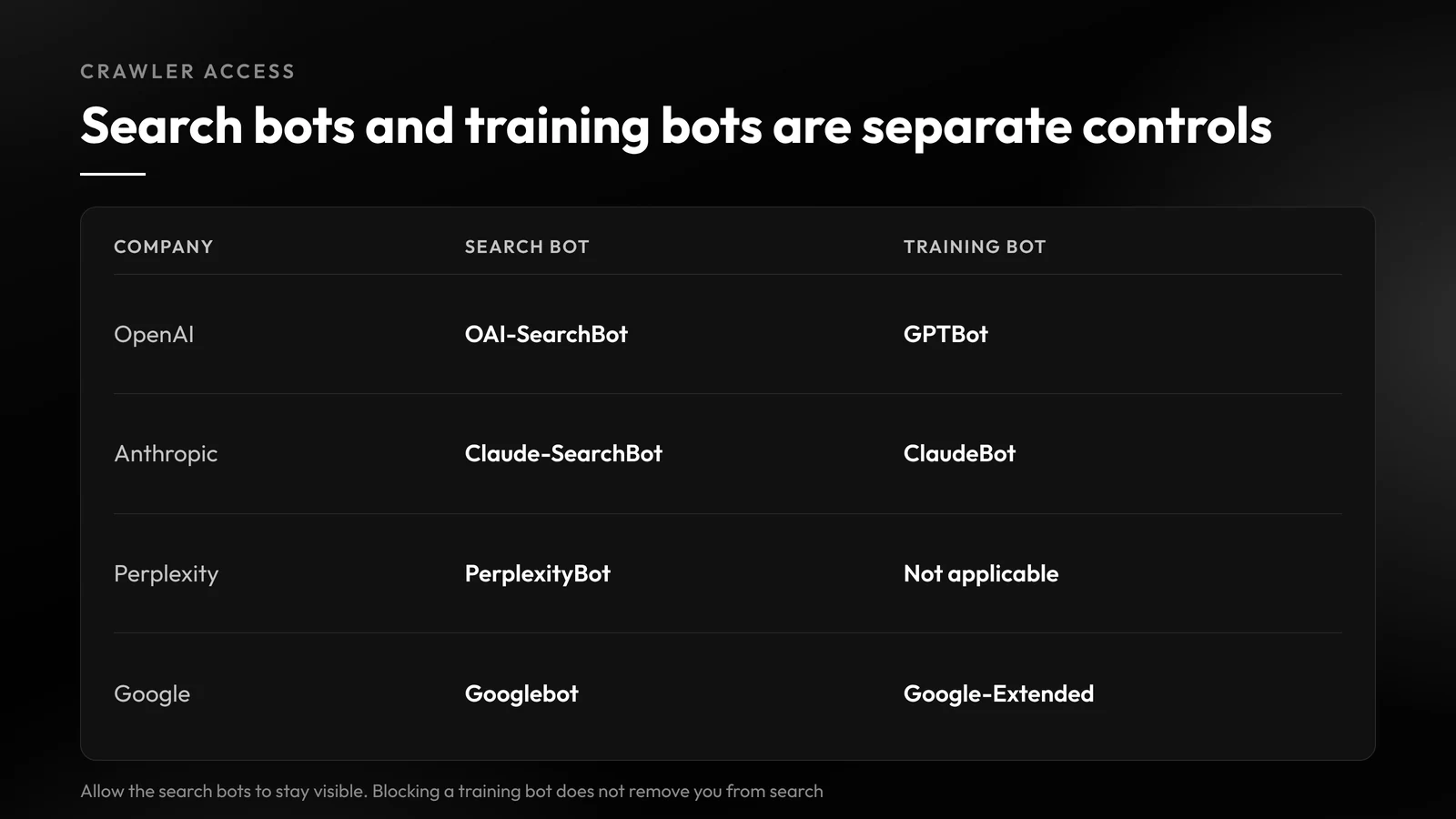
AI companies now run separate bots for search and for training, and blocking the wrong one costs you visibility.
Company | Search or retrieval bot | Training bot | What the docs say |
|---|---|---|---|
OpenAI | OAI-SearchBot | GPTBot | Sites opted out of OAI-SearchBot will not be shown in ChatGPT search answers. Each setting is independent |
Anthropic | Claude-SearchBot | ClaudeBot | Disabling Claude-SearchBot may reduce your site's visibility in Claude's search results |
Perplexity | PerplexityBot | Not applicable | PerplexityBot is not used to crawl content for AI foundation models |
Googlebot | Google-Extended | Google-Extended does not affect inclusion or ranking in Google Search |
You can allow the search bots and block the training bots if you want visibility without contributing training data. For Google's AI features, use snippet controls such as nosnippet or max-snippet, not robots.txt. Check your CDN and firewall rules too, since bot protection often blocks these crawlers silently. Our robots.txt generator covers the AI crawler directives.
2. Be in the indexes AI engines search
AI engines retrieve before they write. For Google, a page must be indexed and eligible to show a snippet, and Google says there are no additional requirements. OpenAI says ChatGPT search uses third-party search providers, so set up Bing Webmaster Tools alongside Search Console. For commerce and local businesses, keep Merchant Center feeds and Business Profiles current, since product and business details often feed AI answers directly.
3. Make content easy to extract and cite
This is where the research is clearest. The "GEO: Generative Engine Optimization" paper from researchers at Princeton, Georgia Tech, the Allen Institute for AI, and IIT Delhi, published at KDD 2024, tested content changes across 10,000 queries. It found:
Adding citations to sources, quotations, and statistics produced a relative improvement of 30% to 40% in visibility.
Overall, GEO methods could boost visibility by up to 40% in generative engine responses.
Keyword stuffing performed 10% worse than the baseline on Perplexity.
Citing sources gave a 115.1% visibility increase for websites ranked fifth in search results, suggesting lower-ranked pages gain the most.
These are lab results, not live traffic, but they line up with Google's guidance to publish original content with first-hand expertise. In practice: answer each question in the opening lines of its section, keep every figure next to its source and date, and use tables for comparisons.
Equally important is what you can skip. Google's 2026 guidance says you do not need AI text files, special schema markup, or content broken into tiny pieces. Our llms.txt guide explains why llms.txt is not a lever.
4. Build brand mentions across the web
AI answers lean heavily on what other sites say about you. Ahrefs studied 75,000 brands and found branded web mentions had the strongest correlation with AI Overview visibility (0.664), well ahead of backlinks (0.218). It is a correlation, not proof of cause, but it matches what you see when you check which pages AI engines cite.
The work here looks like digital PR: original data journalists want to cite, genuine participation in communities, current review profiles, and inclusion in the editorial lists your category gets compared in. Google warns that inauthentic mentions are less helpful than they might seem, so earn them.
5. Measure what you can
AI search is harder to measure than rankings, but the free data has improved a lot in 2026.
Google Search Console includes AI Overviews and AI Mode traffic in the Performance report under the Web search type.
Bing Webmaster Tools launched an AI Performance report in February 2026 showing citation counts for Copilot and Bing's AI summaries.
utm_source=chatgpt.com is added automatically to ChatGPT referral links, according to OpenAI.
Prompt testing across engines, run several times per prompt, shows whether you are mentioned or cited. Our guide on how to check if AI models cite your brand covers the full method, and the AI visibility checker gives a quick baseline.
What AI traffic is actually worth
Set expectations honestly. AI referrals are still a small slice of total traffic, but the quality is high.
Source | Finding |
|---|---|
SE Ranking (June 2026, 101,574 sites) | AI platforms sent 0.32% of all website traffic, up from 0.24% in 2025 and 0.02% in 2024 |
Conductor (2026 benchmarks, data from 2025) | AI referral traffic was 1.08% of all website traffic across 10 key industries, with 87.4% of it from ChatGPT |
Similarweb (July 2026) | ChatGPT's share of generative AI web visits fell from roughly 76% a year earlier to around 53% |
Adobe (June 2026) | AI retail visitors converted at a 54% higher rate than non-AI traffic, and generated 53% more revenue per visit in May 2026 |
Pew Research Center (July 2025) | Users clicked a traditional result in 8% of visits with an AI summary, against 15% without one |
Two conclusions follow. AI answers reduce some classic clicks, so being in the answer matters more than ranking just below it. And according to Adobe, AI-referred retail visits convert well, which is why the channel deserves budget even at its current size. If you want to model the return for your own site, our AEO ROI calculator helps.
Also note that ChatGPT's dominance is shrinking, per Similarweb. Optimizing for one engine alone is a narrowing bet.
Common mistakes
Treating it as separate from SEO. Google says its AI features are rooted in its core ranking systems. Weak SEO means weak AI visibility.
Blocking AI search bots by accident. CDN bot protection is the usual culprit. Check your logs for OAI-SearchBot, PerplexityBot, and Claude-SearchBot.
Blocking training bots and assuming you have opted out of AI search. They are separate controls.
Chasing hacks. llms.txt, special schema, and content chunking are not required, according to Google.
Only optimizing your own site. Third-party mentions carry a large share of the weight.
Measuring with a single prompt run. AI answers vary run to run. Use repeated tests and report a rate.
Important notes
This article is for educational purposes and reflects the position as of October 2026. AI platforms, crawlers, and their documentation change frequently.
Usage figures come from Google, OpenAI, and Microsoft. Research figures come from published studies by Ahrefs, SE Ranking, Conductor, Similarweb, Adobe, Pew Research Center, Gartner, and the authors of the GEO paper, whose methods and samples differ.
None of these studies observes the internal systems of any AI provider. Treat correlations as signals, not guarantees.
Read more from the team: browse all our posts.
Frequently asked questions
What is AI search optimization?
The practice of making your content and brand more likely to be cited or recommended in AI-generated answers from tools such as ChatGPT, Google AI Overviews and AI Mode, Gemini, Perplexity, and Copilot.
How long does AI search optimization take?
Technical fixes such as crawler access can take effect quickly. OpenAI says robots.txt changes reach ChatGPT search in about 24 hours. Content and brand mention work takes longer, similar to SEO.
How much traffic does AI search send?
Studies in 2026 put it between roughly 0.3% and 1% of total website traffic, depending on the sample. It is growing, and Adobe found AI-referred retail visits converted at a 54% higher rate than other traffic in 2026.
Do I need llms.txt for AI search?
No. Google says Google Search ignores these files, so they neither help nor harm visibility.
See more
Want this run on your site?
We do the sitewide version, with the fixes prioritised and shipped.

